
San Angelo City Directory Collections by Year
San Angelo city directories are not one unbroken series. The known shelf includes Worley volumes, later R. L. Polk issues, National Archives microfilm, and a broad FamilySearch collection. Each has a different route to the reader. Start with the exact year needed, then record both the source and its gap. A library catalog entry or an online index can point to a volume, but the printed page remains the best place to confirm how a particular San Angelo name and address were presented.
| Collection | Years | Where Held | Access |
|---|---|---|---|
| Worley San Angelo city directory | 1910, 1925, 1929-30, 1939, 1941, 1952, 1954, 1959 | Academic bibliography; confirm local shelf at Tom Green County Library | Bibliographic lead; inspect the volume when located |
| R. L. Polk San Angelo city directory | 1962, 1963, 1965, 1967-70, 1972, 1974, 1976, 1978 | UT Austin directory citation; local holding not confirmed | Catalog citation and local-library inquiry |
| NARA city directories | 1927-31 and 1934 | National Archives microfilm guide | Microfilm is not sold; ask a library about access or lending |
| U.S. City and Business Directories | About 1749-1990 collection | FamilySearch | Online search; account and image rules can vary |
| Tom Green County Library genealogy materials | Current books and microfilm resources | Stephen Central second floor, with North and West branches | In person, with routine training available |
The Worley sequence has real breaks, and the Polk list is not a promise that every intervening year survives. UT Austin specifically cites January 1965 and 1967 through 1970, then 1972, 1974, 1976, and 1978. NARA separately identifies San Angelo for 1927 through 1931 and 1934. Treat a missing volume as a missing snapshot, not proof that a person left San Angelo.
San Angelo City Directory Publishing Trail
The known chronology helps choose the next source when one year is absent. A 1909 San Angelo Press-News item reported a newly issued John F. Worley Company directory compiled from 1908-09 material. The bibliography then identifies a 1910 volume and later Worley runs. Polk appears in the later run. This is a useful way to frame a San Angelo city directory search, but it does not establish that the person of interest appeared in every volume.
- 1908-09: the Press-News reported a new Worley directory compiled from local material.
- 1910-1959: the bibliography identifies selected San Angelo Worley runs, with gaps between them.
- 1927-31 and 1934: the National Archives guide lists San Angelo city directories on microfilm.
- 1962-1978: Polk runs appear in the bibliography and UT Austin citation record, with the cited gaps preserved.
That sequence is a research timeline, not a continuous publication claim. Write down the publisher because a change of publisher can also change the arrangement, abbreviations, and coverage of a San Angelo city directory.
San Angelo City Directory Research at Stephen Central
The Tom Green County Library genealogy service is the first local stop for a San Angelo city directory search. Its Stephen Central location has a second-floor genealogy area, routine training, books, and microfilm. The library also names FamilySearch, HeritageQuest, Fold3, African American Heritage, historical newspapers, census resources, Sanborn material, and Standard-Times microfilm. Those companions help test whether a directory line belongs to the person sought.
A library visit is particularly useful when a FamilySearch result gives only a partial index line or when a printed abbreviation needs to be seen on the page. Note the volume year, page, section, street spelling, and abbreviated street type. The North and West branches are also named in the genealogy resource listing, but the second-floor space at Stephen Central is the documented place for the genealogy collection and microfilm.
The library genealogy resource page shows the San Angelo city directory research setting and the related databases available to a patron.
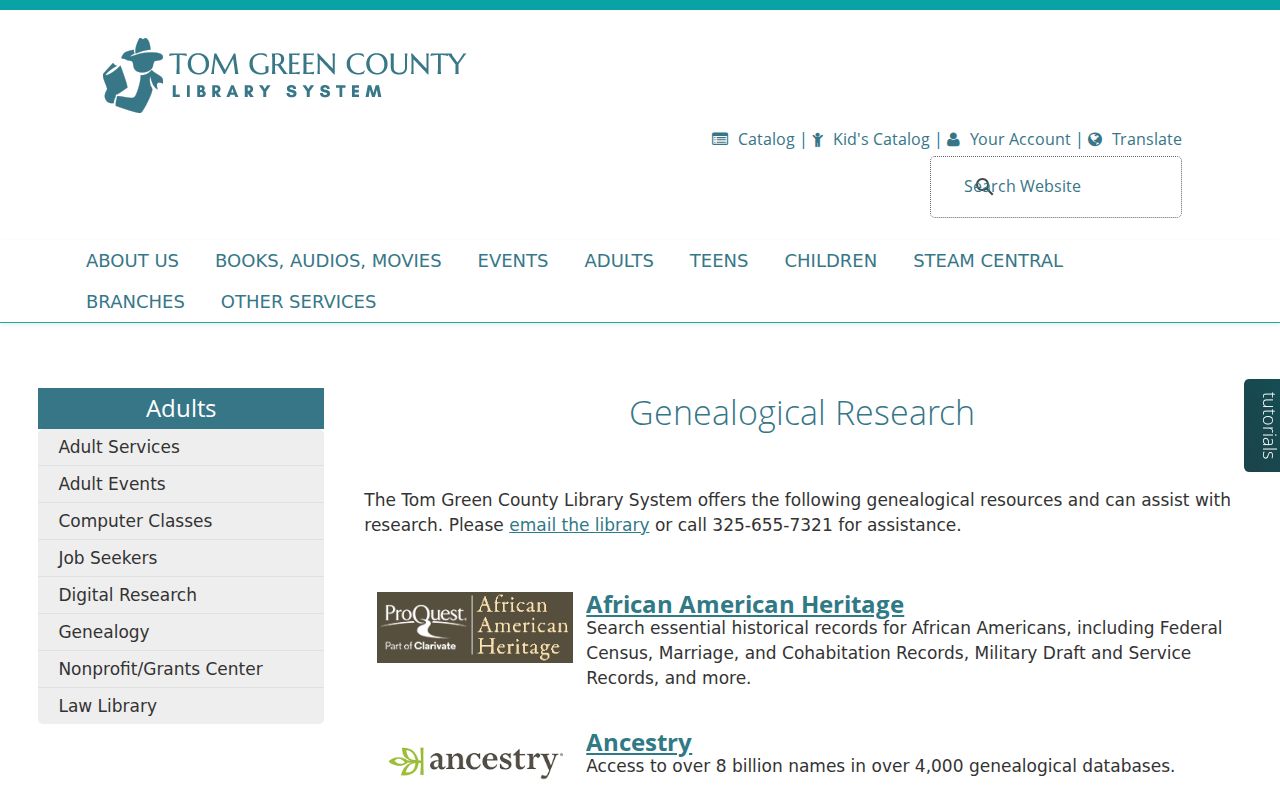
Use the listed newspapers, census tools, and microfilm as checks on a directory entry rather than as replacements for the volume itself.
San Angelo City Directory Searches on FamilySearch
FamilySearch lists a U.S. city-and-business directory collection covering about 1749 through 1990. Its search interface supports Keyword, Location, Type, Batch Number, Film/Fiche/Image Group DGS, and Principal fields, along with exact-search and translation options. For a San Angelo city directory query, combine the place with a surname, a street fragment, or an alternate spelling. The collection metadata supports name, address, occupation, and category research, but an indexed snippet may omit part of the printed line.
Search results need a page-level check. Add Tom Green when a broad San Angelo search returns too much, and try initials as well as a full given name. Record the film, fiche, or image-group identifier when shown. This preserves a route back to the source if an index changes or a later researcher needs to compare the transcription with the image.
Reading a San Angelo City Directory Entry Safely
No opened San Angelo entry and no local abbreviation key were available during the research pass. For that reason, a San Angelo city directory entry should be described only by fields supported by the collection and the volume in hand. The reliable inventory is modest: a person name, address, occupation or category, directory year, publisher, and directory section. The page should be checked before treating any additional mark as a local convention.
| Person name | The named entry as printed, including initials or spelling variants. |
|---|---|
| Address | A printed street address or other address line where the volume supplies one. |
| Occupation or category | A described occupation or directory category when present in that entry. |
| Year and publisher | The volume date and the company responsible for that directory. |
| Directory section | The alphabetical, street, business, or other section visible on the page. |
- Criss-cross directory
- An address-arranged section that can be used to start from a street rather than a name, if the volume contains one.
- Householder index
- A name-oriented index for household entries when a particular directory supplies it. Its presence has to be checked in the volume.
- Abbreviation key
- The volume's explanation of shortened terms. No local key was verified, so photograph or note the key from the same San Angelo volume before interpreting a mark.
Do not assume that every San Angelo city directory gives a spouse, a phone number, a household roster, an ownership mark, or any particular address notation. Those details may appear in some directories elsewhere, but the local form has not been confirmed here.
San Angelo City Directory Address Sections
An address-first search works only when the chosen San Angelo city directory actually includes an address-arranged or criss-cross portion. First inspect the contents and the abbreviation key. If a reverse section exists, copy the street heading, house number, page, and the exact person line. If it does not, use the alphabetical listing and pair it with a street map or a parcel record instead of guessing that a reverse listing exists.
Exact San Angelo reverse-directory years and shelf locations were not verified in the local material. That gap matters. The current by-address record path belongs on the San Angelo street directory lookup; historical volumes are best used here as dated snapshots rather than as a substitute for a current record.
Note: A reverse section can connect a San Angelo address to a printed line, but it does not prove that every person at that address was listed.
Tracing San Angelo City Directories with Census Records
A household trail begins with a person, street, or approximate year. The goal is not to turn a single San Angelo city directory line into a conclusion. It is to create a dated path that can be checked against other records. Publication year and field-collection year may differ, so keep both when the volume reveals them. Federal census releases add a separate household snapshot after the applicable 72-year release period.
- Search FamilySearch or a local San Angelo volume with the known name, street, or approximate year.
- Record the title, publisher, year, page, section, street spelling, and every visible person or address line.
- Move one available directory year backward and forward, keeping a gap log rather than filling years that were not found.
- Pair a near-year San Angelo directory address with the available federal census snapshot for household composition.
- Check a deed, CAD mailing or situs field, newspaper notice, probate item, cemetery record, or voter district before drawing an identity conclusion.
A changed address can reflect a move, a different spelling, a life event, a renumbered street, or simply a directory gap. A disappearance can mean the same range of possibilities. When a historic name needs a current official-record check, use the San Angelo resident lookup workflow to choose a suitable custodian.
San Angelo City Directory Clues from SAGHS
The San Angelo Genealogical & Historical Society offers the Stalkin' Kin name index, an unclaimed marriage-license list, cemetery links, a surname registry, research services, and links to regional collections. Stalkin' Kin reports 216,051 names across volumes 1-26 and 39-48, plus supplements 11-17. The unclaimed-license list reports more than 3,700 Tom Green County licenses that were never picked up. Both are useful San Angelo city directory companions, not substitutes for the cited book or county record.
SAGHS name-index links provide a practical way to test a surname before spending time on a distant volume or microfilm request.
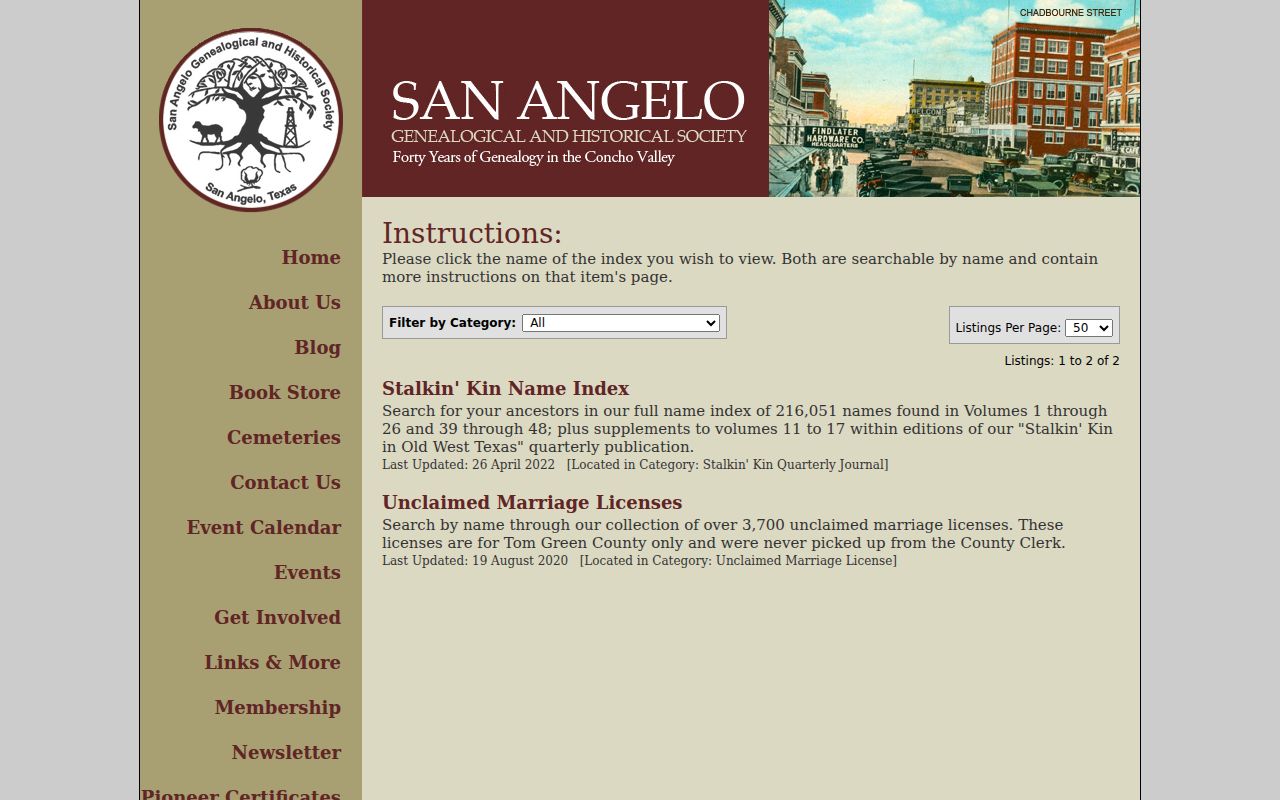
A positive name hit is a lead. Preserve the cited volume, page, source date, and any linked underlying record before attaching it to a household trail.
San Angelo City Directory Streets in Map Context
A San Angelo city directory can name a street, but it cannot show the block around it. The August 1904 Sanborn set has 15 sheets, and the 1920 street-to-sheet index helps locate a street on the later map set. These maps provide building, business, block, and land-use context. They are not a roll of residents, so a map label should not be turned into a person-level finding.
The Portal to Texas History 1920 Sanborn street-to-sheet index is a useful geographic companion for an address copied from a San Angelo city directory.
Match the directory's printed street spelling to the index, then retain the sheet number with the directory citation so the geographic check can be repeated.
San Angelo City Directory Polk Citations
UT Austin's citation record is a useful bibliographic checkpoint for later San Angelo city directory years. It specifically identifies January 1965 and the 1967-70, 1972, 1974, 1976, and 1978 Polk runs. That list helps avoid treating an assumed annual sequence as fact. It also gives a publisher citation to carry into a library or archive inquiry.
The UT Austin Polk directory citation displays the cited San Angelo run and publisher information.
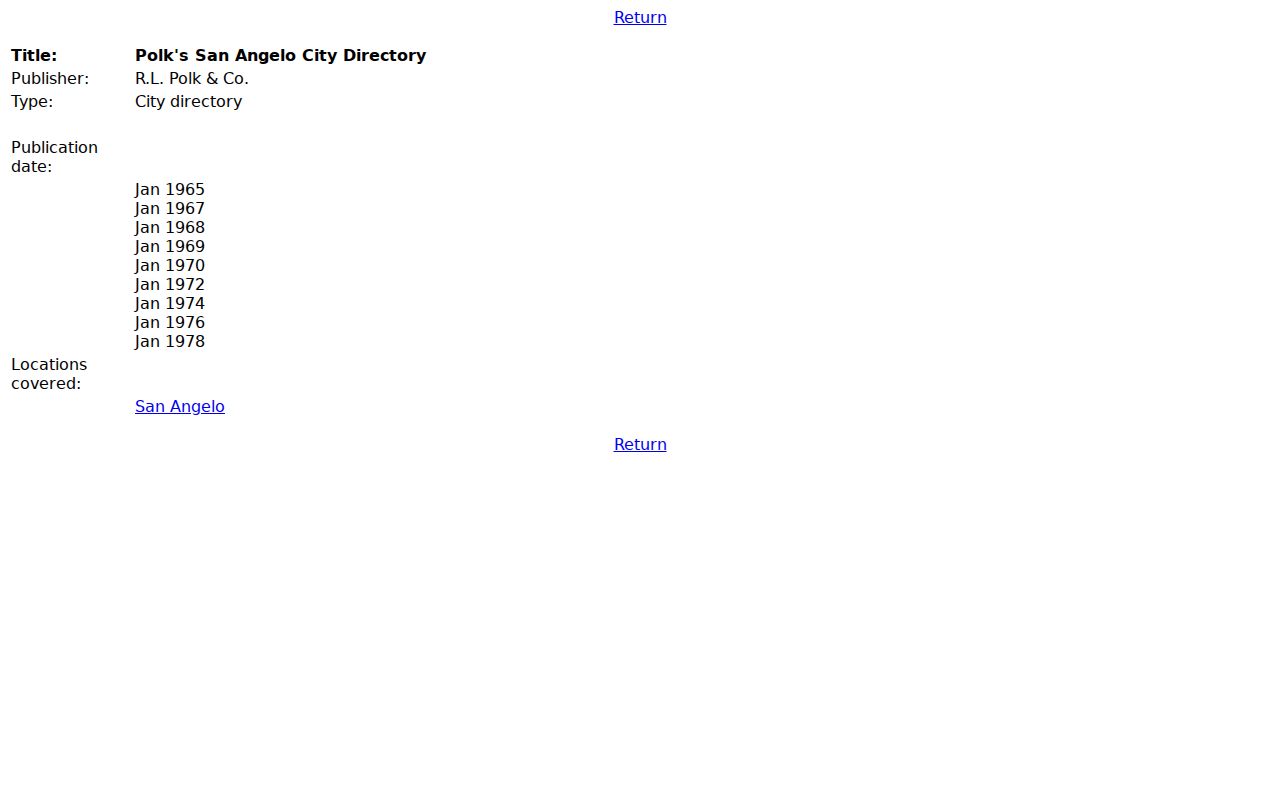
Use the cited years to plan a search, then confirm the physical or digitized volume and its page before relying on an entry.
San Angelo City Directory Archive Follow-Up
Fort Concho's Research Library and Archives can supply local context after a San Angelo city directory identifies a street or name. The City-operated archive has served as a reference library and archive since 1969 and holds books, journals, maps, microfilm, oral histories, photographs, and frontier and military collections. Research is by appointment, with registration and handling rules. Its 325-657-4442 contact number is listed for an appointment inquiry.
The Fort Concho Research Library and Archives is especially useful when a directory address needs historical context. It is not documented as a confirmed local shelf for every Worley or Polk volume, so ask about the precise year before a visit. The National Archives city-directory guide remains another route for the microfilm years.